Category: News

  • Solana DApps Generate $22 Million in Revenue in a Week, Led by Pump.fun as TVL Surpasses $12 Billion and Launchpad Volume Falls

    Solana DApps Generate $22 Million in Revenue in a Week, Led by Pump.fun as TVL Surpasses $12 Billion and Launchpad Volume Falls

    What happened?

    Solana DApps generated over $22 million in protocol revenue last week, led by memecoin launchpad Pump.fun which pulled in $9.65 million. Jupiter, Axiom, Phantom and several other protocols also contributed as total value locked climbed above $12 billion and 24‑hour DEX volume hit about $4.44 billion. At the same time bonding curve volumes for memecoin launchpads fell below $1 billion for the first time in six months, though Pump.fun still accounts for roughly 84% of launchpad volume.

    Who does this affect?

    Traders and everyday users feel it through higher trading activity and fees on Solana, which can affect slippage and execution costs. DApp teams, launchpads and liquidity providers are directly impacted by the revenue flows and the heavy concentration of memecoin activity around a single platform. Investors, stakers and SOL holders are also affected because rising TVL and protocol revenues influence token demand and market sentiment.

    Why does this matter?

    The surge in revenue, TVL and trading volume signals growing real economic activity on Solana, which can support stronger SOL demand and positive market sentiment. But the concentration of memecoin liquidity in Pump.fun and the drop in overall launchpad volumes raise fragility risks—if that activity cools further, revenues could roll over quickly. In short, this trend can boost short‑term prices and confidence, yet traders should watch key support (around $180) since a break could trigger broader downside.


  • Massachusetts Weighs State-Backed Bitcoin Reserve in Public Finance Push

    Massachusetts Weighs State-Backed Bitcoin Reserve in Public Finance Push

    What happened?

    Massachusetts lawmakers set a hearing for October 7 to consider creating a state-backed Strategic Bitcoin Reserve under Senate Bill S.1967, introduced by Senator Peter J. Durant. The proposal would let the state buy and hold Bitcoin as part of its reserves, pitched as a hedge against inflation and a way to diversify assets. The move echoes similar state and federal efforts and marks another step toward treating Bitcoin as a mainstream option in public finance.

    Who does this affect?

    This affects Massachusetts taxpayers and state officials who would decide whether public money can be allocated to Bitcoin and under what rules. It also matters to investors, crypto companies, custody providers, and other states watching for precedent that could shape their own policies. Pension funds, treasurers, and financial managers could face new requirements around security, accounting, and custody if the plan moves forward.

    Why does this matter?

    If Massachusetts, other states, or the federal government start officially holding Bitcoin, it would legitimize BTC as a sovereign asset and likely boost institutional demand. That could put upward pressure on prices and reduce some regulatory uncertainty, but it would also increase volatility and highlight custody and accounting challenges. Large, coordinated sovereign purchases and international competition for reserves could tighten supply and change how investors and funds allocate risk.

  • Shiba Inu Exchange Reserves Fall to Record Low as Whales Accumulate, Signaling Potential Breakout

    Shiba Inu Exchange Reserves Fall to Record Low as Whales Accumulate, Signaling Potential Breakout

    What happened?

    Shiba Inu exchange reserves fell to a record low of about 84.5 trillion tokens as holders and whales pulled coins off exchanges into self-custody, per CryptoQuant and Nansen. The top 100 whale addresses increased their SHIB holdings roughly 15% over the past year to about 102.44 trillion. At the same time, technicals show a bounce from a four-month symmetrical triangle with RSI and MACD beginning to flip bullish and a key breakout level at $0.0000145.

    Who does this affect?

    This affects SHIB holders and meme-coin traders most directly, since reduced exchange supply favors long-term holders and makes quick selling harder for short-term traders. Whales and smart-money addresses stand to benefit from accumulating while exchanges face thinner liquidity in their order books. Broader crypto investors and participants in related presales (like Maxi Doge) could also be influenced as attention and capital rotate among meme tokens.

    Why does this matter?

    With fewer tokens on exchanges, selling pressure is lower and price moves can be amplified, making a breakout more likely and opening the door to targets like $0.000025 (≈110% upside) or even $0.00005 (≈340%) if macro catalysts such as rate easing and spot ETF flows drive demand. Whale accumulation signals smart-money conviction, which can shift retail sentiment and accelerate rallies once momentum builds. Overall, the trend increases the chance of a surprise pump but also raises volatility because exchange liquidity is thinner.

  • XPL Rallies After Plasma Mainnet Launch, Viral Airdrop and Exchange Listings

    XPL Rallies After Plasma Mainnet Launch, Viral Airdrop and Exchange Listings

    What happened? Plasma’s mainnet launch, a viral airdrop and exchange listings sent XPL surging.

    Plasma (XPL) launched its mainnet and hit major exchanges, driving the price up to $1.68 — about a 3,260% gain from the $0.05 presale. A viral airdrop that gave users nearly 9,000 tokens for a $1 deposit amplified the hype and created huge windfalls at the peak. The token has since pulled back toward a $1.10 demand zone, but technicals suggest buyers could push it higher again.

    Who does this affect? Early investors, airdrop recipients, traders, and anyone chasing altcoin presales and airdrops.

    Presale buyers and airdrop recipients saw massive paper gains and many now hold positions that could be sold or used for further trading. Traders and exchanges benefit from the spike in volume and volatility, while retail investors and meme-coin communities are aggressively hunting similar opportunities. New projects and presales, like Pepenode, stand to gain attention and capital as people look for the next big return.

    Why does this matter? It redirects capital and attention across crypto markets, boosting short-term liquidity and volatility with broader market implications.

    A runaway token like XPL brings fresh liquidity and retail FOMO into small-cap altcoins, which can spark an altcoin season and lift many related projects. If buyers defend key supports and drive a rebound, capital could rotate from established players to newer chains, creating big winners but also increasing the chance of sharp corrections. Overall, this trend raises both upside potential and systemic risk — more volume and speculation can fuel fast rallies, but they can also trigger rapid sell-offs that ripple through the market.

  • Prediction markets tilt toward Mamdani after Adams exits NYC mayoral race

    What happened?

    After Mayor Eric Adams abruptly ended his reelection bid citing fundraising troubles, bettors on the Kalshi prediction market put newcomer Zohran Mamdani’s chances of winning New York City’s mayoral race at about 83%. Andrew Cuomo trails at roughly 16% in the same market, while Republican Curtis Sliwa is down near 2%. The sudden exit reshuffled the contest with just over a month to go until Election Day and drove a rapid swing in market expectations.

    Who does this affect?

    This affects New York City voters and the campaigns for Mamdani, Cuomo, and Sliwa who now have to adjust strategy and fundraising plans on short notice. It also hits donors, political operatives, and local stakeholders who were backing Adams or planning for a different race dynamic. On the federal side, President Trump and his allies—who’ve already signaled opposition to a Mamdani win—may influence funding and policy responses if the market’s favorite ends up winning.

    Why does this matter?

    Prediction markets moving so strongly toward Mamdani can change media narratives, donor behavior, and where political capital flows in the final stretch of the campaign. A potential threat from Washington to withhold federal funding raises real risks for municipal budgets and could ripple into municipal bond markets and city services planning. Broader policy differences—like Mamdani’s ideas on city-owned groceries and free buses versus Cuomo’s approach—could shift local economic priorities and affect sectors tied to city policy, while also influencing investor and donor expectations.

  • BitMine Holds 2.65 Million ETH, Becomes the World’s Second-Largest Corporate Ethereum Treasury

    BitMine Holds 2.65 Million ETH, Becomes the World’s Second-Largest Corporate Ethereum Treasury

    What happened?

    BitMine disclosed it now holds about 2.65 million ETH (roughly $11 billion) as part of $11.6 billion in total crypto and cash, after adding roughly 234,846 ETH last week. The stock jumped more than 6% on the news but remains down about 4% over the past week. That buying spree makes BitMine the world’s second-largest crypto treasury and gives it roughly a third of all corporate-held Ethereum.

    Who does this affect?

    This matters to Ethereum investors and traders because a huge buyer taking coins off the market can change supply dynamics and price behavior. It also affects exchanges and custodians as institutional flows move toward self-custody and staking, leaving fewer coins on exchange books. BitMine shareholders and rival corporate treasuries feel the ripple — shareholders are watching whether these buys translate into sustained stock gains while competitors fall further behind in ETH holdings.

    Why does this matter?

    Institutional accumulation like BitMine’s can tighten available supply and help underpin ETH prices, especially as exchange balances hit multi-year lows. That concentration can increase short-term volatility and make price moves more sensitive to large buys or sells, so any breakout above resistance could be sharp but may include pullbacks. More broadly, big corporate treasuries shaping token supply shifts market sentiment and could accelerate institutional adoption trends like staking and long-term holding.

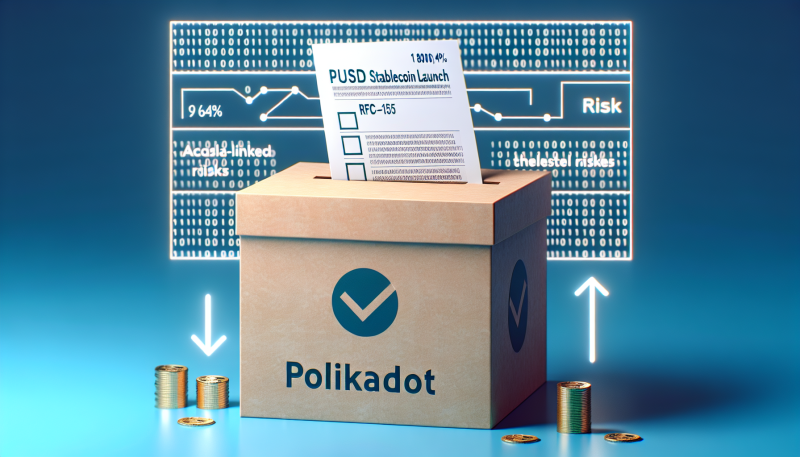
  • Polkadot Votes on pUSD Stablecoin Launch (RFC-155) With 80.4% Threshold and Acala-Linked Risks

    Polkadot Votes on pUSD Stablecoin Launch (RFC-155) With 80.4% Threshold and Acala-Linked Risks

    What happened?

    The Polkadot community is voting on a proposal (RFC-155) to launch pUSD, a DOT-backed algorithmic stablecoin deployed on the Asset Hub using the Honzon protocol. The referendum currently shows about 74.62% Aye versus 25.40% Nay but needs an 80.40% approval threshold to pass. The plan has reignited debate because it’s linked to Acala’s tech and the collapse of aUSD, which left many community members wary.

    Who does this affect?

    DOT holders and on-chain governance participants are directly affected because pUSD would use DOT as collateral and change how capital is allocated on Polkadot. DeFi projects, validators, and users who need native stable assets would see new options and risks if pUSD launches. Centralized stablecoin issuers like USDC and USDT could lose some dominance inside Polkadot if a native option gains traction.

    Why does this matter?

    If approved, pUSD could increase demand for DOT as collateral, tighten supply dynamics, and potentially support DOT’s price or staking economics. A native stablecoin would keep more liquidity and DeFi activity inside Polkadot and reduce reliance on external stablecoins, helping the network capture more market share. But the Acala connection and past exploits raise the risk that a failed launch could damage trust and scare away capital, while a smooth rollout could make Polkadot a bigger player in the booming stablecoin market.

  • Binance launches Crypto-as-a-Service white-label platform for regulated institutions to offer crypto under their own brands

    Binance launches Crypto-as-a-Service white-label platform for regulated institutions to offer crypto under their own brands

    What happened? Binance launched Crypto-as-a-Service (CaaS), a white-label platform that lets regulated institutions offer crypto trading and custody under their own brand.

    Binance announced a pilot of CaaS that provides backend trading, custody, settlement, and compliance tools while letting firms keep their own front ends and client relationships. The pilot opens on September 30 for selected banks and brokerages, with broader availability planned later in the year. The platform supports internalized matching with routing to Binance’s global order books, plus dashboards and APIs for KYC and transaction monitoring to reduce the cost and complexity of building in-house systems.

    Who does this affect? Licensed banks, brokerages, exchanges, and the clients they serve who want regulated access to crypto.

    Initially the service targets licensed banks, broker-dealers, and exchanges that meet Binance’s scale requirements and are invited to the pilot. Asset managers, wealth managers, and traditional financial firms that don’t want to build crypto infrastructure from scratch can adopt the white-label solution to offer crypto products under their own brand. Retail and institutional clients of those firms could get easier, regulated access to crypto services through familiar providers instead of going directly to crypto-native platforms.

    Why does this matter? It could speed institutional adoption, change where liquidity sits, and reshape market competition and fees.

    By lowering technical and compliance barriers, CaaS may bring more traditional financial firms into crypto, increasing distribution and competition for custody and trading services. Tapping Binance’s liquidity while allowing internalized matching could deepen overall market liquidity but also concentrate execution and settlement through a major venue, affecting where prices form. Wider adoption could boost trading volumes and capital inflows, put pressure on fees and spreads, and likely draw greater regulatory attention as incumbents scale crypto offerings.

  • Swift and Consensys Lead a Consortium of More Than 30 Global Banks to Build a Blockchain-Based Shared Ledger for 24/7 Cross-Border Payments

    Swift and Consensys Lead a Consortium of More Than 30 Global Banks to Build a Blockchain-Based Shared Ledger for 24/7 Cross-Border Payments

    What happened?

    Swift announced it is building a blockchain-based shared ledger with Consensys and a consortium of more than 30 global banks to record, sequence, and validate transactions directly. The first prototype will target real-time, 24/7 cross-border payments and aims to sit alongside existing fiat rails. The design emphasizes interoperability with public and private ledgers, CBDCs, tokenized assets, and commercial bank money.

    Who does this affect?

    Major global and regional banks involved in cross-border payments will be the first to feel the impact as they help shape the system’s architecture and governance. Payment processors, fintechs, asset managers, corporates that move money across borders, and central banks exploring CBDCs could all need to adapt to new interfaces and settlement processes. Technology vendors, token providers, and firms offering smart-contract and interoperability services stand to gain new business as incumbents modernize infrastructure.

    Why does this matter?

    If successful, a Swift-backed shared ledger could shorten settlement times, lower reconciliation and liquidity costs, and enable 24/7 value transfer, which changes how banks manage cash and FX risk. That shift would increase competition with existing correspondent banking and payment rails, push demand for tokenization services and interoperable infrastructure, and likely accelerate investment in blockchain-enabled settlement. For markets, this could mean tighter spreads, faster asset mobility, new revenue opportunities for infrastructure providers, and fresh regulatory focus as real-world money moves on chain.

  • DOGE Whales Sell More Than 40 Million Tokens as Volume Surges and Price Tests 200 Day EMA

    DOGE Whales Sell More Than 40 Million Tokens as Volume Surges and Price Tests 200 Day EMA

    What happened?

    Big holders sold more than 40 million DOGE in a single 24‑hour stretch, triggering sharp downward pressure. At the same time, on‑chain data shows whales had been quietly accumulating since August 12, growing from about 10.7 billion to over 11 billion tokens. Price action bounced near the 200‑day EMA with trading volume up ~60% and a small 2% uptick as DOGE retested the $0.22 area.

    Who does this affect?

    This move hits whale wallets and early holders who were taking profits, and it shakes out some smaller retail traders who panic‑sold into the dip. It also matters to altcoin traders and speculators watching technical support levels and new presales like Maxi Doge that are sucking up short‑term liquidity. Exchanges and market makers feel it too, because the spike in volume increases order flow and short‑term funding risks.

    Why does this matter?

    Volatility from whale selling can act as a shakeout that clears weak hands and sets the stage for a stronger rally if key support like the 200‑day EMA holds. If the bounce continues, targets like $0.28 (and far‑out calls at $1) become more plausible, which could draw fresh capital into Dogecoin and the broader altcoin market. Meanwhile, hot presales and leveraged meme projects can amplify price moves and rotation, making this a potentially catalytic moment for altcoin season.