Category: News

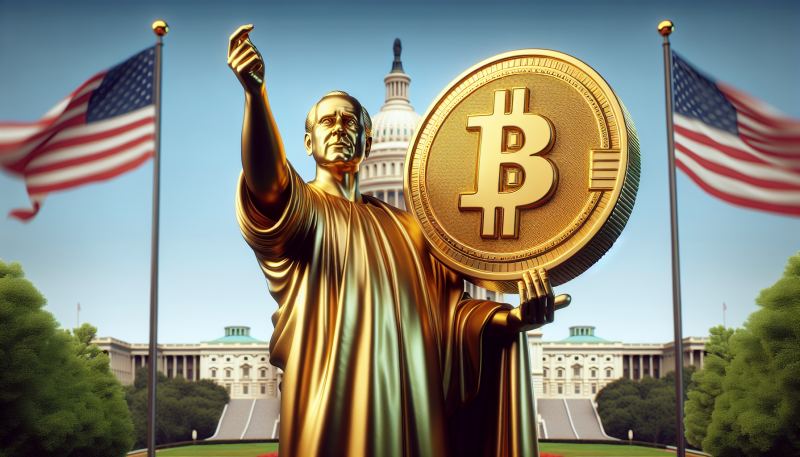
  • Trump’s 12-Foot Golden Bitcoin Statue Unveiled Near Capitol, Blending Politics and Cryptocurrency

    Trump’s 12-Foot Golden Bitcoin Statue Unveiled Near Capitol, Blending Politics and Cryptocurrency

    What happened?

    A 12-foot golden statue of former President Donald Trump holding a Bitcoin was unveiled near the US Capitol. This event was organized by Pump.fun memecoiners as a tribute to Trump’s support for Bitcoin and decentralized finance. The unveiling event also saw a Trump-themed memecoin launched on a live stream.

    Who does this affect?

    This action primarily affects the crypto community, especially supporters of Bitcoin and meme coins. It also engages political commentators and followers of Trump’s activities since it blends blockchain culture with national politics. Furthermore, it aims to stimulate public discussion about the future of government-issued currency across the broader population.

    Why does this matter?

    This event is significant because it represents the intersection of modern politics with financial innovation. By acknowledging Trump’s role in championing Bitcoin and other decentralized technologies, it underscores the potential of cryptocurrencies influencing the political landscape. Moreover, it occurred during a time of renewed bullishness across risk markets, including crypto, due to a Federal Reserve’s rate cut.


  • North Korean Hackers Target Crypto Industry with Sophisticated Infiltration Tactics

    North Korean Hackers Target Crypto Industry with Sophisticated Infiltration Tactics

    What happened?

    Binance founder, Changpeng Zhao, issued critical alerts about North Korean hackers initiating sophisticated infiltrations into crypto companies. These infiltrations are done through deceptive job applications, counterfeit interview processes, and the bribery of employees. The hackers have stolen over $2.2 billion in the first half of 2025 alone by creating legitimate U.S corporations and deploying Python-based malware that steals credits from over 80 browser extensions and crypto wallets.

    Who does this affect?

    This impacts a significant array of entities within the crypto industry – from large businesses to individual professionals such as developers and security personnel who may be targeted for the fake job interviews. The hackers’ infiltration campaigns also involve establishing multiple legitimate business entities in the US, putting American businesses and identities at risk. Furthermore, these attacks have resulted in substantial financial losses, affecting investors across the board.

    Why does this matter?

    The extensive cyber-attacks reflect the vulnerability of the crypto industry and how susceptible it is to sophisticated hacking. The substantial financial losses experienced as a result of these attacks could potentially deter investors and impede the growth of the market. Also, since these hacks are linked back to North Korea’s weapons program, they bear significant geopolitical implications, necessitating urgent international attention and response for their prevention.

  • Bullish Crypto Exchange Reports Major Financial Turnaround and Expands Regulatory Reach in 2025

    Bullish Crypto Exchange Reports Major Financial Turnaround and Expands Regulatory Reach in 2025

    What happened?

    Crypto exchange Bullish experienced a significant financial comeback in Q2 of 2025, reporting a net profit of $108.3 million. This is a dramatic improvement from the $116.4 million loss it suffered during the same quarter in the previous year. Along with this financial triumph, Bullish has also managed to expand its global regulatory reach by obtaining New York’s BitLicense.

    Who does this affect?

    This turnaround primarily impacts the investors and stakeholders of Bullish as the company’s financial health significantly improves. In addition, clients and potential users of the crypto exchange are affected as Bullish strengthens its position in the market and expands its services. The acquisition of key licenses, notably the BitLicense, allows Bullish to offer crypto spot trading and custody services in New York, broadening its service offerings and increasing its user base.

    Why does this matter?

    This impressive turnaround bodes well for the cryptocurrency market as a whole, with Bullish showing that profits can be realized even in the volatile world of crypto trading. This positive performance, coupled with enhanced regulatory compliance, could attract more participants to the crypto market and potentially stabilize it. Furthermore, Bullish’s success and strategic positioning might inspire other crypto exchanges to follow suit and strive for a stronger and more compliant operational framework.

  • South Korea Launches First Korean Won-Backed Stablecoin KRW1 on Avalanche Blockchain

    South Korea Launches First Korean Won-Backed Stablecoin KRW1 on Avalanche Blockchain

    What happened?

    South Korean digital asset custodian, BDACS, has launched the country’s first Korean won-backed stablecoin on the Avalanche blockchain. This stablecoin named KRW1 is fully collateralised by actual Korean won deposits held at Woori Bank. The launch comes after a successful proof of concept phase validating the feasibility of this stablecoin.

    Who does this affect?

    This development has implications for banks, users, and institutions that are part of the Avalanche blockchain ecosystem. BDACS, with support from Avalanche, aims to shape Korea’s digital economy with the launch of KRW1. Additionally, other financial institutions in Korea, like Kakao Bank, Kookmin Bank, and the Industrial Bank of Korea, who have filed for Korean won stablecoin trademarks, could be influenced by this initiative.

    Why does this matter?

    The launch of KRW1 is a significant step towards regulated, bank-integrated digital money in Korea. It not only lowers payment processing fees but also enables its use as a “low-cost payment and settlement system” for public-sector programs, which could establish it as a standard for stablecoins in Korea. This move contributes to the ongoing trend of traditional finance players entering the stablecoin market in South Korea.

  • Bitcoin Rallies Towards $118,000 as Cryptocurrency Market Capitalization Reaches $4.2 Trillion Following Fed Rate Cut

    Bitcoin Rallies Towards $118,000 as Cryptocurrency Market Capitalization Reaches $4.2 Trillion Following Fed Rate Cut

    What happened?

    The global cryptocurrency market capitalization increased by 2% to $4.2 trillion, primarily driven by Bitcoin’s steady rise toward $118,000 after the Federal Reserve made its first interest rate cut of the year. Despite the central bank’s guarded tone about future policy moves, collateral impacts were seen as Bitcoin traded 1% higher at $117,426, and Ether and XRP rose by 2.8% and 2.9% respectively.

    Who does this affect?

    This development impacts cryptocurrency traders, investors, and blockchain projects. Traders had anticipated the Fed’s decision, which had a 96% probability. Andrew Forson, president of DeFi Technologies, suggests that lower borrowing costs could result in increased capital flow into digital assets. Also, staking products and blockchain projects might become viable alternatives to traditional bonds.

    Why does this matter?

    This matters due to the potential market impact. Historically, cryptocurrency rallies often follow rate cuts after a delay. The cautious stance adopted by Fed Chair Jerome Powell, combined with uncertainty surrounding inflation and growth, has kept short-term volatility subdued even though risk asset sentiment is improving. Liquidity-sensitive assets are expected to perform well if the easing cycle continues, indicating that the Fed’s decisions can significantly influence the cryptocurrency market.

  • US SEC Approves New Rules for Crypto Spot ETFs, Paving the Way for Market Expansion

    US SEC Approves New Rules for Crypto Spot ETFs, Paving the Way for Market Expansion

    What happened?

    The US SEC approved new listing rules for major exchanges, enabling a potential surge of crypto spot exchange-traded funds. This decision clears the path for asset managers seeking to launch spot ETFs tied to cryptocurrencies beyond Bitcoin and Ether. The new system can reduce the time from filing to launch to as little as 75 days, compared to the previous process that could last up to 240 days or more.

    Who does this affect?

    This decision primarily affects asset managers and exchanges, who will no longer need to undergo lengthy case-by-case reviews. In particular, filings tracking Solana and XRP, which have been in limbo for more than a year, are likely to be the first beneficiaries. The move is also significant for the administration of President Donald Trump, signaling strong support for digital assets.

    Why does this matter?

    The market impact of this decision is substantial, indicating a shift in US policy towards digital assets. The streamlined rules could potentially apply to any cryptocurrency with at least six months of futures trading on the Coinbase Derivatives Exchange, possibly triggering the launch of numerous altcoin ETFs. The changes reflect a growing willingness to bring digital assets into the mainstream financial system with established safeguards.

  • Cryptocurrency Market Surges After Federal Reserve Rate Cut, Impacting Investors and Market Trends

    Cryptocurrency Market Surges After Federal Reserve Rate Cut, Impacting Investors and Market Trends

    What happened?

    The cryptocurrency market cap experienced a 2.2% surge within 24 hours, exceeding $4.2 trillion. This increase occurred in the aftermath of a 25 basis point rate cut by the Federal Reserve, which renewed optimism across risk assets. Subsequently, Bitcoin rose by 1.1% to $117,700, Ethereum surpassed $4,600 and the Meme sector surged by over 5%, though SocialFi lagged for a second consecutive day.

    Who does this affect?

    This development impacts a broad set of stakeholders within the crypto market. Investors, whether holding Bitcoin, Ethereum, or other cryptocurrencies within the Meme sector, would find their assets appreciating. On the other hand, those invested in SocialFi may not be experiencing the same level of gain. Also, the lowered rates might entice potential investors to enter the market.

    Why does this matter?

    This is significant because it indicates the interplay between traditional financial policy decisions, such as Federal Reserve interest rate adjustments, and the crypto market. Evidently, this market reaction underscores how crypto investors’ sentiments and actions can be influenced by such policy changes. Consequently, this could impact market trends, strategy, and the broader economic landscape surrounding cryptocurrencies.

  • US Imposes Sanctions on Iranian Nationals for $100 Million Cryptocurrency Scheme Supporting Terrorism and Arms Development

    US Imposes Sanctions on Iranian Nationals for $100 Million Cryptocurrency Scheme Supporting Terrorism and Arms Development

    What happened?

    The US Department of the Treasury’s Office of Foreign Assets Control (OFAC) has imposed sanctions on two Iranian nationals, Alireza Derakhshan and Arash Estaki Alivand. The sanctions come as a result of the individuals’ involvement in facilitating over $100 million in cryptocurrency transactions related to oil sales for the Iranian government. These financial activities included alleged support for regional proxy terrorist organizations and advancements in weapon systems, specifically ballistic missiles.

    Who does this affect?

    The sanctions predominantly affect the individuals involved, Alireza Derakhshan and Arash Estaki Alivand, along with the wider network of front companies that they utilized, including entities based in Hong Kong and the United Arab Emirates. The actions taken by OFAC will also impact Iran’s Islamic Revolutionary Guard Corps-Qods Force (IRGC-QF) and the Ministry of Defense and Armed Forces Logistics (MODAFL), as these parties reportedly benefited from the shadow banking activities in question.

    Why does this matter?

    The sanctions highlight the increasing use of cryptocurrencies in illicit activities globally, which in turn may influence future regulatory efforts within the digital asset space. This move by the US government underscores how cryptocurrencies can be used to bypass traditional financial systems and evade sanctions. Consequently, the actions may not only affect the geopolitical relations between the US and Iran, but may also lead to increased scrutiny and regulation in the cryptocurrency market as a whole.

  • KOSCOM Applies for Stablecoin Trademarks, Signaling South Korea’s Embrace of Digital Currency

    KOSCOM Applies for Stablecoin Trademarks, Signaling South Korea’s Embrace of Digital Currency

    What happened?

    Korea Exchange’s IT infrastructure affiliate KOSCOM has applied for five stablecoin-related trademarks including the KSDC, KRW24, KRW365, KOSWON, and KORWON brands. This is in addition to reorganizing its crypto and digital assets departments. The move is aimed at proactively responding to the imminent launch of the KRW stablecoin market in South Korea.

    Who does this affect?

    This development impacts South Korea’s financial securities and futures markets, which KOSCOM supports with comprehensive tech solutions and trading platforms. It also has implications for the Southeast Asian nations where KOSCOM has provided trading platform solutions such as Laos, Cambodia, and Malaysia. Businesses and consumers engaging with digital currency transactions may also be interested in this news.

    Why does this matter?

    This matters because KOSCOM’s move into the stablecoin space is a significant marker of South Korea’s and the broader Asian market’s embrace of digital currencies. Its anticipation of new crypto regulations from the government shows the growing importance of crypto markets and the integration of stablecoins into financial systems. This could boost payment convenience and stability in subscription and distribution processes, thus transforming the digital asset market.

  • Cryptocurrency Market Sees Growth and Regulatory Changes Amidst All-Time Highs

    Cryptocurrency Market Sees Growth and Regulatory Changes Amidst All-Time Highs

    What happened?

    The digital asset market is maintaining a high level of activity, with Bitcoin reaching an all-time high last month and altcoins seeing significant capital influxes. XRP (Ripple), Pi Coin, and Solana are identified as particularly strong investments. Policy changes from Washington, such as President Trump’s GENIUS Act for stablecoin regulation and the SEC’s Project Crypto, have also added to the optimism in the sector.

    Who does this affect?

    This development affects all players in the cryptocurrency market, including investors, traders and specific project teams like those behind XRP, Pi Coin and Solana. The policy changes also have implications for regulators and other financial institutions that must navigate the evolving landscape of digital assets.

    Why does this matter?

    This matters because it shows the continued growth and acceptance of cryptocurrency in the financial market. The strength of these altcoins, coupled with favourable regulatory developments, could mean more opportunities for profit and innovation within the industry. Therefore, being aware of these developments assists in making informed investment decisions.