Category: News

  • Pi Network Faces Major Decline as Value Drops 16% Amid Crypto Market Turmoil

    Pi Network Faces Major Decline as Value Drops 16% Amid Crypto Market Turmoil

    What happened?

    Pi Network’s value has dropped by 16% in just 24 hours, with the current price around $0.5128, influenced by broader crypto market declines due to tariff and recession worries. Over a week, it’s down 38%, and an alarming 74% over the month, causing fears of a death spiral as investor confidence wanes. The token now sits 82% below its all-time high from February, with no new exchanges showing interest to list it amid the uncertain economic backdrop.

    Who does this affect?

    This steep decline impacts both current investors of Pi Network, who are seeing significant losses, and potential investors who may be wary of investing in a currency experiencing such volatility. It also affects those mining Pi, as declining prices could make the reward less attractive compared to costs involved. Additionally, blockchain platforms that might have integrated or planned to integrate Pi Network could face disruptions if interest continues to decline.

    Why does this matter?

    The falling value of Pi Network signals potential issues in the broader cryptocurrency market, where uncertainties such as global tariffs and recession fears can sharply affect asset values. These shifts could trigger ripples across other digital currencies, affecting market stability and investor confidence. As Pi struggles to rebound and fails to gain listings on major exchanges, it further exemplifies the risks associated with highly volatile and speculative tokens in the crypto ecosystem.

  • PEPE Cryptocurrency Plummets Over 75% Amid Economic Turbulence and Tariff Fears

    PEPE Cryptocurrency Plummets Over 75% Amid Economic Turbulence and Tariff Fears

    What happened?

    The PEPE cryptocurrency, a popular meme coin, has seen its value plummet by over 75% from its all-time high due to a sell-off prompted by recent economic turbulence. Trump’s “tariff war” has sparked recession fears, leading to mass liquidations across various investment markets, including cryptocurrencies. While PEPE managed a slight gain for the month, it suffered a significant drop this week amidst broader market volatility.

    Who does this affect?

    Investors in meme coins like PEPE are directly affected as these coins have become particularly volatile and susceptible to market downturns. The broader crypto market also feels the impact as it remains sensitive to global economic uncertainties triggered by political moves like tariffs. These events not only influence individual investors but also ripple through financial markets, affecting portfolios and investment strategies globally.

    Why does this matter?

    This situation highlights the interconnectedness of geopolitical events and financial markets, where political decisions can lead to significant economic consequences. The decline in PEPE’s value underscores the volatility of meme coins and their heightened risk profile, causing caution among investors. As traditional markets and cryptocurrencies show vulnerability, investors must consider the potential market impact and strategize accordingly to navigate ongoing economic challenges.

  • Bitcoin’s Evolving Role: From Digital Gold to High-Tech Equity

    Bitcoin’s Evolving Role: From Digital Gold to High-Tech Equity

    What Happened?

    The recent volatility in Bitcoin prices is sparking discussions among analysts at Swiss crypto bank Sygnum, who compare its behavior to high-growth tech stocks rather than traditional safe-haven assets like gold. Despite endorsements from key figures like Federal Reserve Chair Jerome Powell touting Bitcoin as a potential store of value, Sygnum’s research highlights a shift in perception regarding Bitcoin’s role in the financial market. They argue that Bitcoin’s price movements now resemble those of high-beta technology equities more than a stable hedge asset.

    Who Does This Affect?

    This shift in Bitcoin’s perception impacts investors, particularly new entrants into the crypto market who might be looking for a secure store of value. Sygnum’s analysis indicates that despite Bitcoin traditionally being viewed as “digital gold,” the current trends suggest it has become a gateway for new crypto investors, overshadowing Ethereum even amidst weak interest in spot Ethereum ETFs. Thus, anyone considering Bitcoin as a safe-haven investment should reevaluate its risk characteristics in line with its current market behavior.

    Why Does This Matter?

    The changing nature of Bitcoin’s market perception could significantly impact its future as a reserve asset, affecting institutional and retail investor strategies alike. If Bitcoin continues to behave similarly to tech stocks rather than as a hedge against market instability, it may lose its appeal as a secure investment during economic downturns. The long-term implications depend on U.S. policy decisions, which will guide whether Bitcoin maintains its status as a safe-haven asset or continues as a volatile, market-sensitive investment.

  • Cosmos ($ATOM) Sees 10% Price Rally Amid eToro Staking Launch, But Year-to-Date Decline Persists

    Cosmos ($ATOM) Sees 10% Price Rally Amid eToro Staking Launch, But Year-to-Date Decline Persists

    “`html

    What happened?

    Cosmos ($ATOM) experienced a 10% price rally, reaching a local high of $4.86 after eToro announced the launch of staking for Cosmos and Polkadot. This allows users to earn rewards by holding these assets, boosting short-term interest. However, despite this increase, $ATOM’s value remains down 57.3% year-to-date, indicating ongoing challenges.

    Who does this affect?

    This affects the Cosmos community, investors, and users who participate in staking and governance on the network. The integration with eToro may attract more users interested in earning staking rewards, thereby impacting both existing and potential investors. Additionally, the interoperability developments within the ecosystem could have implications for developers and projects building on the Cosmos network.

    Why does this matter?

    The market impact is significant as the increased staking capabilities and interoperability advancements might enhance the utility and attractiveness of the Cosmos network. Despite the ascent, concerns about potential security issues tied to a Lazarus Group connection could hinder investor confidence. The technical analysis suggests the token is trying to form a base, but the uncertainty around security and sustained price recovery remains a pivotal factor for future performance.

    “`

  • Sharp Decline in DeFi Total Value Locked Signals Challenges Ahead for Cryptocurrency Market

    Sharp Decline in DeFi Total Value Locked Signals Challenges Ahead for Cryptocurrency Market

    What happened?

    The total value locked (TVL) in decentralized finance (DeFi) has dropped more than 30% since reaching a peak of $137 billion in December, now sitting at $94.49 billion. This decline coincides with a broader retreat in the cryptocurrency market following an initial rally after the election of a pro-crypto U.S. president. Various economic challenges, along with regulatory concerns, have curbed the previous optimism and impacted both DeFi TVL and major cryptocurrencies like Bitcoin and Ether.

    Who does this affect?

    This affects investors and participants in the DeFi ecosystem, as well as the broader cryptocurrency market. Investors who put their assets in DeFi are seeing a reduction in the value of their holdings due to the decrease in TVL. Additionally, crypto enthusiasts and users are impacted by the uncertainty brought on by regulatory changes and global economic factors that can influence the direction of the market.

    Why does this matter?

    Understanding the market impact is crucial because the decline in DeFi’s TVL reflects waning confidence, which could signal whether DeFi will grow or face further setbacks. The repeal of the controversial “DeFi broker rule” by the U.S. Senate and House might boost confidence by removing potential regulatory barriers, suggesting policymakers are open to fostering a more favorable environment for DeFi growth. However, the industry still faces significant challenges regarding complexity, cost, and accessibility that need addressing to achieve mainstream adoption and market resilience.

  • Cryptocurrency Market Faces Downturn Amid New Initiatives for Web3 and Asset Security

    Cryptocurrency Market Faces Downturn Amid New Initiatives for Web3 and Asset Security

    What happened?

    The cryptocurrency market experienced a downturn, with the global market capitalization decreasing by 2.5% over the last 24 hours. Most top 100 coins by market cap are seeing red, with Pi Network (PI) and Toncoin (TON) suffering significant declines. Meanwhile, BNB Chain launched an accelerator program for Web3 projects, and Bybit partnered with Zodia Custody to enhance asset security for institutional clients.

    Who does this affect?

    This affects cryptocurrency investors and traders who may be concerned about the current market downturn. It also impacts the 16 Web3 projects selected for the BNB Chain accelerator program, as they stand to benefit from mentorship and potential funding. Lastly, Bybit’s institutional clients are affected positively by improved security measures through their partnership with Zodia Custody.

    Why does this matter?

    The market downturn can influence investor sentiment and lead to caution in trading activities. The BNB Chain accelerator program could stimulate innovation and growth in the Web3 space, potentially impacting market dynamics positively. Bybit’s partnership with Zodia Custody represents a step toward bolstering trust and security in crypto asset management, which is crucial for institutional adoption and market stability.

  • Solana Faces Price Decline Amid Market Turbulence Following Trump’s Tariff Announcement

    Solana Faces Price Decline Amid Market Turbulence Following Trump’s Tariff Announcement

    “`html

    What happened?

    Solana (SOL) has experienced a turbulent week with its price dropping by 8% to $115 due to former U.S. President Donald Trump’s tariff announcement, impacting financial markets globally. The overall crypto market also felt the shock, as major cryptocurrencies like Bitcoin and Ethereum saw declines of over 4%. Technical analysts have warned that if Solana’s price falls below a critical support zone, it could lead to further significant drops.

    Who does this affect?

    This situation affects crypto traders and investors holding Solana (SOL), as well as those involved in Bitcoin, Ethereum, and other cryptocurrencies experiencing market volatility. It also impacts stakeholders in the broader Solana ecosystem, including those using decentralized applications and exchanges on its network. Additionally, institutional players like Fidelity, who are interested in Solana, are keeping a close eye on these developments and the potential approval of their Solana ETF filing.

    Why does this matter?

    The market impact is significant as Solana approaches a critical support level, which could lead to a sell-off if breached, potentially taking the price below $100. Despite this, institutional interest remains strong, evidenced by Fidelity’s spot Solana ETF filing, indicating confidence in Solana’s liquidity and trading volume. These dynamics highlight the tension between short-term price volatility and long-term growth potential in the Solana ecosystem, making this a pivotal moment for market observers.

    “`

  • Coinbase Seeks Approval to Launch XRP Futures Trading with CFTC

    Coinbase Seeks Approval to Launch XRP Futures Trading with CFTC

    What happened?

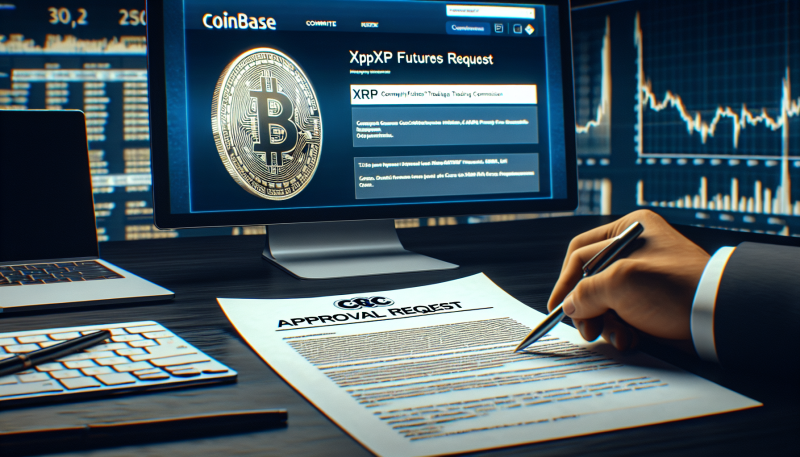
    Coinbase has filed for the ability to offer XRP futures trading with the US Commodity Futures Trading Commission (CFTC). This move will allow Coinbase Derivatives to provide a regulated platform for capital-efficient exposure to XRP, one of the most liquid digital assets. The contract is expected to go live on April 21, 2025, with details to be released closer to the launch date.

    Who does this affect?

    This development primarily affects traders and investors interested in cryptocurrency futures, particularly those seeking exposure to XRP. With the XRP futures contract, both institutional and retail investors will have more options for trading under a regulated framework. It also impacts the broader crypto market by potentially increasing XRP’s visibility and trading volume.

    Why does this matter?

    The introduction of XRP futures trading through Coinbase could significantly impact the crypto market by providing a structured way to invest in XRP. This move could lead to increased liquidity and interest in XRP, potentially impacting its price. Furthermore, as crypto derivatives make up a large portion of global crypto volume, offering XRP futures in the US could shift some of that activity from overseas markets to a regulated US venue.

  • Fortnite’s New Dill Bits Feature Links Gaming and Cryptocurrency, Sparking a Memecoin Surge

    Fortnite’s New Dill Bits Feature Links Gaming and Cryptocurrency, Sparking a Memecoin Surge

    What happened?

    Fortnite introduced a new feature in its latest update that includes hidden “Dill Bits” mining server locations within the game map. This addition to the game sparked interest in a previously lesser-known Solana-based memecoin also named Dill Bits. Players can find these hidden areas and destroy mining equipment to earn in-game resources called Dill Bits, which have become popular for in-game trades.

    Who does this affect?

    This development affects Fortnite players who now have an opportunity to engage with crypto-themed content while playing the game. It also impacts the cryptocurrency market by influencing the demand for the real-world Dill Bits coin as players and investors show renewed interest. Additionally, it affects gaming and crypto enthusiasts who are excited about the seamless integration of blockchain elements into mainstream games like Fortnite.

    Why does this matter?

    This matters because the introduction of crypto-themed features in popular games like Fortnite could signal a growing trend of integrating blockchain concepts in mainstream gaming. The sudden 200% price surge of the Dill Bits memecoin following this update highlights the significant market impact such integrations can have. As gaming networks and cryptocurrencies grow more intertwined, the gaming industry might witness increased opportunities for new investment avenues and player engagement strategies.

  • Trump’s Global Tariff Announcement Triggers Market Turmoil and Heightened Interest in Bitcoin

    Trump’s Global Tariff Announcement Triggers Market Turmoil and Heightened Interest in Bitcoin

    What happened?

    President Trump has imposed a new global tariff, starting at 10%, affecting various countries worldwide, with some facing even higher rates. This move led to a significant negative market reaction, including the largest single-day point loss in Nasdaq 100 history. Arthur Hayes, former CEO of BitMEX, shared his opinion on social media, stating that these tariffs are beneficial for Bitcoin and gold in the medium term.

    Who does this affect?

    The tariffs impact not only the countries targeted but also global markets and investors in both traditional financial systems and cryptocurrencies. The increased tariffs may lead to a weakening dollar and potential retaliatory measures from countries like China, affecting trade and global economic stability. Cryptocurrency investors, particularly those focused on Bitcoin, are paying close attention as changes in fiat currency dynamics could influence Bitcoin’s value.

    Why does this matter?

    The implementation of global tariffs might result in increased volatility in traditional markets, potentially leading investors to seek alternative assets like Bitcoin. Arthur Hayes suggests that the expected correction of global imbalances through monetary policy adjustments, such as potential Fed easing or QE, can enhance Bitcoin’s appeal. Market players note that while the crypto market isn’t immune to macroeconomic shocks, Bitcoin might gain traction as confidence in fiat currencies wavers, hence influencing its price trajectory positively in the long-term despite short-term challenges.